
Mar 20, 2013

Which baby teething necklace is best for my baby?

This is one of the questions which i get quite often. I though it would be good idea to write a blog entry which would help to make a decision.

There are couple things which are important when deciding what you need: surface and color.

SURFACE:
There are few kinds of teething necklace's surfaces: raw, unpolished, polished, heated.

Raw Baltic amber necklaces have untreated beads. Beads are selected, drilled and made in to necklaces. "Sharp edges" give massage which increases blood circulation, which help for healing process and to distribute substances which are absorbed through skin. They have most of surface, so easier than other bead types releases amber acid. You may read more about amber acid in following blog's post:
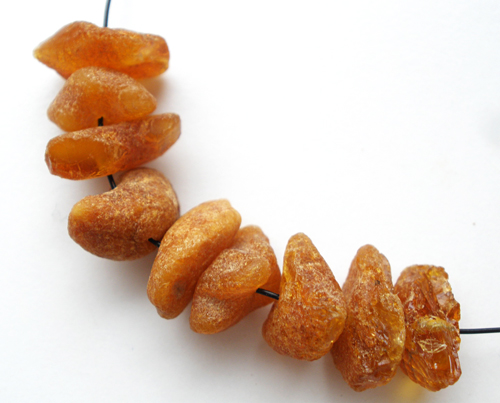
                                                                  Raw Baltic amber

Unpolished Baltic amber is such kind of amber where amber is shaped ir "sharp" edges are treated, but matte surface is left. Such kind of beads has smaller surface in total than raw amber, but it usually touches skin with more surface than raws. For this reason such amber is a bit less effective or has same affect as raw amber.

                                                        Unpolished Baltic amber

Polished Baltic amber is such kind of amber where surface is polished to shiny state. Polishing might be done in abrasive way (abrasive-polishing dust, sand paper) or by heating. Such amber has less surface in total, harder releases healing oils and amber acid, but looks much more beautiful. I have got many letters which wrote that such amber helped to solve various issues, so it has healing properties for sure too. 
                                                             Polished Baltic amber.

Heated  Baltic amber is such kind of amber which was effected by heat to change some properties like: to enhance color, to change color, to increase clearness, sometimes heat might be used as a way to polish. Most (not all) cherry color amber is heated. I suggest to search for sellers who inform is amber heated or not.
The more amber is heated the lower healing properties it has. So slightly heated amber has slightly lower healing properties than polished amber. Amber heated to the point where it will change color (like in cherry amber case), has lowest healing properties from all ambers.
                                                                    Heated Baltic amber

COLOR
Cherry color Baltic amber.
As mentioned before, most of cherry Baltic amber is heated. Looks amazing, has some healing properties, but there can be and more effective colors to heal.

                                                            Cherry color Baltic amber

White color Baltic amber
It is almost opposite of  cherry color. It contains so much amber acid, that when burned as incense it has sour smell. Less than 1% of Baltic amber is in white or very light yellow color, so for this reason and for healing properties this color is very valued. White Baltic amber is always polished or unpolished, because in raw state it is in dark yellow or brown color due to surface oxidation. 
 White color Baltic amber

Yellow color Baltic amber.
Cloudy or opaque ambers usually have a bit higher healing properties, but clear or semi clear yellow amber is something what gives amber name "Sun stone" - it looks like pieces of Sun. Yellow is color of energy, and everyone needs energy especially if there is health problem. So yellow amber is universal amber.
                                                               Yellow color Baltic amber

Brown color Baltic amber . 
Brown amber is very good for various problems but it especially helps body to remove what is unnecessary to it. So if there is digestion problems, toxins in the body, skin blemishes and so on, brown amber is what you need. 
                                                              Brown color Baltic amber

Red Baltic amber.
Red amber gives more energy to become active, trust in you own abilities. Helps to man's and boys reproductive organs. So it is balanced for grown up people, unless you child needs encouragement or healing powers for boys reproductive organs.
                                                             Red  color Baltic amber

Black Baltic amber.
Jet black amber is something what people in ancient times avoided. It was used to guide soul safely in to afterlife and in black magic. People did not worn black amber but had somewhere at home "in case it would be needed". Children under 10-11 years old should not wear any black stones, amber especially. Many people forgot this knowledge and are selling black amber teething necklaces as something cool, for some sellers money is something more important that the results for the customers.
        Black color Baltic amber (few beads are cherry, that can be seen from shade which they drop)
Amber color Baltic amber.
We do not have such name of color in our (Lithuanian) vocabulary, so we add those pieces to yellow, brown or red ambers depending on shade.

Conclusion:
My personal favorite necklaces are unpolished or raw necklaces in white, yellow or light brown/honey colors. When my friends ask for polished necklaces I recommend yellow & white necklaces, somethimes not heated honey color necklaces.

I hope this blog entry will be helpful to you!


Baltic amber teething necklaces at my shop:
https://www.etsy.com/shop/amber4you?section_id=10413188
My Baltic amber shop: amber4you.etsy.com

It might also be interesting for you to read:
What is amber and Baltic amber?
How Baltic amber can be used for healing and what is amber acid?
What is amber for? (some information)
About ambers of the world and copal
Who am I? (about me)

Jan 19, 2012

Mother goddess.. reincarnated.

One of the oldest objects of worshiping on earth was Mother goddess. Woman, mother, the one who gives birth to everything what is alive, the one who gives food, the one who takes care of everything.

In my ancestor's lands, now known as Baltic lands mother goddess was main figure in all times, even today. Woman was always special here, each woman. It is known as before Indo European came with their male pantheon, in almost all Europe mother goddess was the main figure of worshiping and there ware matriarchy as a social structure.

My ancestors at least 7 generations before me are from tribe named Žemaičiai [Zh e m a i tʃ i a i], tribe know for stubbornness and keeping of traditions. Even today some of Žemaičiai call them selves not Lithuanians (as country is named under tribe which united many tribe to fight against christian sacred war, which was the longest in whole Europe's history sacred christian war - crusaders war). We feel that we have separate identity than other Lithuanians. Even our language has such dialect that other Lithuanians (other 3 of 4 tribes which are under name of Lithuania today) are not able to understand it easily. We have kept many of old traditions and worshiping of mother goddess is very strong today. As we are Christianized now, mother goddess reincarnated in to Maria. I think most of the calling Lithuania "Land of Maria" is influenced by my tribe (Žemaičiai).

As we had oral tradition and Christianity tried to cover up everything carefully, there are informational gaps today in many traditions of my land. Some says we had runes as writing system, but they ware destroyed together with our sacred places. But it is fact that for a long time our old pantheon of gods ware in the territories of churches, even today it is possible to find statues of our old gods in territory of few churches. Funny isn't it? 600 years from the time our land is Christianized, and old traditions are still alive.

The goddess which was closest with it's image to Mother goddess is Žemyna [Zh e m i: n a], we call "earth" as "žemė" [zh e m e] (can't find sound in English which would fit the last sound of Lithuanian word). So name Žemyna comes from word of žemė (earth), or žemė (earth) comes from Žemyna, I am not sure which comes first. Word "žemė" can be translated not only as "earth" but "soil" too.
I am from family with unknown number of generations who worships Mother goddess. My grandmother always prayed to Maria, my mother did that too.. Jesus is somewhere around, but the one who is asked for help is Maria. As my mother made little altar at her home with photos of her fathers and my father's fathers, Maria also took the main place in it (strong believe in help from ancestors is alive today too, even she does think it is christian thing and I know it is not).

So who was Žemyna?


Above: Goddess Žemyna

Žemyna (Žemė, Žemelė, Žemynėlė, Žemynėlyna - other names of her) is a goddess of earth, soil which gives all the fruits, goddess of everything what is alive. She is goddess of Lithuanian tribes and Prussia. She comes from "Mother of the gods". She has brother Žemėpatis [Zh e m e p a t i s] and they together take care of fields, fruits given by earth, all plants, animals, home and everyone who lives at home.
Mother of gods is said to be the same as Prusian Seva, Latvian's Žemė motina (mother earth), Slavic Živa [Zh i v a]. Goddess of earth where know to all tribes which worked in a fields.
Dievų motina [D i e v u: m o t i n a] (mother of gods) is said to be changed Mother of universe, goddess Lada [l a d a]. For Indo Europeans nations Žemė (Earth) was not only mother, but also wife of heaven god. Žemė gets it's fertility from the first thunder of spring, god Perkūnas [P e r k u: n a s] given water - rain. At that time falls the axe of Perkūnas, which has special power of fertility. And Žemė becomes pregnant. Also fertility of Mother Earth is connected with Sun and Moon. Earth can be fertile only if she has contact with heaven, that means to be warmed by Sun shine (Saulė [S a u l e] - she) and Moon shining (Mėnulis [M e n u l i s] - he), getting rain (lietus [l i e t u s] - he) or dew ( Rasa [ R a s a] - she).
This contact is very seen in art.

Above Maria - Mother goddess and Baltic cross, also known as Sun cross.

In art is usually seen sun, moon, stars, rain motives, also Sun warmness and fire symbolising crosses, plants, blosoms, fruits, animals.

Žemyna is goddess which helps for man who works soil. The bad farmer was the one who didn't worked well soil. Goddess did not blessed such farmer, didn't help to grow crops, gave one misfortune after another.
The Earth (Žemė maitintoja - the earth which gives food) from great respect people kissed on various occasions. Most often they kissed before going to bed, when wake up, starting various works. When kissed the earth chant was "Iš žemės parėjau, į žemelę nueisiu" ( i came from earth i will come to earth). It is very similar to christian "You came from dust, you will become dust".
Earth was kissed and on important moments of life, like girl who is getting married and leaves home of her parents. Before whole family was praying on it's knees, then kissed earth with hope that the one who leave will come back safely.

In old times people gave sacrifices to Earth. Most often they did that when starting various works, and the finishing them.. like sowing crops and taking them off, starting to built house and finishing it, starting new village and so on. Before journey starting to work with soil spilled some beer on earth (beer and the pot was for special occasions) and then drank beer themselves too. Such spill is sacrifice for goddess Žemei (Earth) and god Žemininkui, as a tradition to give drink for Earth.
Also sacrifices ware made when some got birth or someone died.


How Mother goddess influences today's society?
Woman was always the one who takes care of home, man was the one who takes care of fields. They helped each other as they could. So woman was never lower than man in my lands. Well Christianity made some influence and there ware some families where man as the stronger one was over the "sinful" woman, but it was not main course.
Today we have president who is woman, leader of army is woman and prime minister is woman. So 3 of 4 main places in government is taken by woman. Not many "modern" western nations can say about themselves something like this.
Western culture has it's influence on system of values and often working at home, taking care of home and family is something "lower" or "not work". But there are some changes in this.. i believe in bright future :) More and more young people are willing to find out more about our old traditions and to make them alive again.

Lithuanians, with all tribes which unites this name, are one of the fasted dieing out nations in the world. Many young people leave country for "better life" in other European countries, USA, Canada and so on. So if we will not die out, we might be the hope of earth for surviving this "Earth killing age", with our respect for earth, with out philosophy and attitudes.

Be blessed by Mother Earth, from which you came, to which you will come.

Dec 28, 2011

Herb healing - Lithuanian/Baltic tradition today
You may watch video here

http://tv.delfi.lt/video/EA8NKxI7/

Yes. It is in my native language, but if you are interested in herb healing, you may feel the spirit... As many ask me about traditions in my land, i though maybe someone might be interested in this video.

Some thoughts from the film...
"I have married then i was 22 years old. After 2 years tree have killed my husband and 4 week old baby left for me. I was doing everything around house, was working in the fields, because i had to live somehow. I was healing myself just with herbs. Meadows are full of herbs.. Forests are full of herbs"

"Our parents didn't new any chemical medicine, they have healed themselves with herbs"
"This meadow fed us and gave us money too. Oooj.. [like oh] There was time when we all came here.. we ware singing, rolling on the grass.. not like now.. somewhere one granny somewhere another.."
"This Saint-John's-wort [high herb with yellow blossoms], as everyone says, it is  from 99 illness. Saint-John's-worth is just from one illness - nerves. When man doesn't have nerves [nerves/stress problems] he is healthy and doesn't have any illness."
"There wasn't any coffees, any teas, and if there ware then you weren't able to buy them [too high price]. Not like now, old or young drinks coffee.. in those times you drink some kind Saint-John's-worth's tea, then you change [herb].. "
"In those times children ware not born in hospitals, granny of the village helped. When baby if born and is not calm, these nerimnikai ware used [high herbs with bubble shape violet blosoms]. Washed with those nerimnikai."
"
I know those herbs.. various herbs.. maybe 40 kinds of them"


"When i was giving birth for second child i have had clinical death. After that i got vision... reading from palm, diagnosing correctly from palm, ability to search people who disappeared... I guess it is connected with nature, with god"

" And all this plant will be used up [the one with pink blossoms in a swamp]. There are so many people who ask for it.. to heal leukemia, to heal cancer.. It has to be washed up.. only man hand can pull it, it is rooted so deeply and so nicely"
"Herb healer have to be honest with himself, with the one who has illness.. to pick up herbs at the right time, to give right herbs and they will works for sure."
"Today's medicine is coming back to herbs very fast, because it is safer medicine, works well and you may use longer without harming other systems"
"Time comes to every person to decide he wants to heal himself with herbs or with drugs. With herbs you may heal a lot. But again it depends how deep is the illness. You may stop or even heal such serious illness.."
[Storm]"Sweet-flag have to be collected in a storm, when water is turbid. Everything in nature in moved, so sweet-flag gives best healing properties to man"


"Thank you the Fire, Gabijele [ancient Baltic fire goddess] the beautiful one.. that we worked today so well, that you helped me, that ointments are so good..."
"Good day [Sveika as greeting, but also means healthy] forest the green one. How are everyone of you are living today.. birds, my herbs.."
"I was going with my grandmother for the herbs, in such way i have learned to recognize herbs, how to collect them. When i was a student i haven't picked up herbs, but later life has forced me to come back to herbs. You think i was like this all my life? While i have not got ill i wasn't here, it didn't care for me"
"When we ware going with the elders for herbs, we ware making such skudučiai [making instrument from herb stem] that not to be lost somewhere [away from others]. It is very good for children who have various illnesses with lungs, while you blow, you blow out all illnesses"
"The most important is where man lives.. what he breaths, what he eats, what he drinks. The surroundings is very important.. and that changing surrounding.. it does not change itself, man is changing or has to change it."
"I doubt if anyone would be able to talk me away from herbs.. it like dependence upon them now."
"I can not imagine any man near me.. where you saw married witch? [we are not afraid of them here, if they have knowledge we respect them.. there ware not even one inquisition fire in our lands]. When i was young i had a man, even not one. And now.. now i live with my herbs, with my thoughts, with my works.. i could stand here near tree all day"
"[diagnosing girl] I will give you infusion of the snake, your will put 8 drops on sugar, will not feel any taste"


-------------------
I am from herb healers family.. my mother was healing me with herbs.. her father was well known herb healer... This short movie is about my culture and traditions in my lands... I hope to come back to nature soon too... even civilization gave me master degree in university... I do not wish that my children would grow up in town.. I wish they could feel the grass touch the tree, drink tea in a meadow, to see wild animals outside... This is true life, life without stress.. not a life of bio-robot :)

Dec 23, 2011

Christmas time - Lithuanian traditions

24th of December is "Kūčios" [K u: tʃ i o s], this is the main part of Christmas time.
25th of December is Kalėdos [K a l e d o s] (couldn't find exact sound in English which would sound like Lithuanian "ė") first day. When we translate "Christmas" in to Lithuanian, we translate it in to "Kalėdos". One of my friends who is all in Yoga said, that Kalėdos word comes from Vedic "Kali Dao", like from nowadays Hinduism deity Kali. This has a meaning, because Lithuanian language is old and has many similar words with Sanskrit. Also fits with a meaning of re-birthing nature.

Many people celebrate Christmas, not many remembers that it is time when longest nights ends and days starts to become longer. This is why here in Lithuania we have a lot of ancient traditions, because winter solstice was an important event (despite the fact that Christianity became main religion 200-300 years ago ineveryday life)

Of course now here in Lithuania we became "civilized" and old traditions are being forgotten more and more each year. Especially in last 20 years when we became independent from Russia and got more western (American?) influence.

Christmas is a time, when all family gather in parent's home. As people after WW2 ware forcibly moved to towns some old traditions ware changed, lost or lost their meaning.

Forest tree.. Decorations as food for animals.


Christmas tree. The most important Christmas time symbols in the world. According to traditions Christmas tree was decorated just on evening before Christmas (24th of December). It was decorated outside, if forest was near Christmas tree was decorated in forest. Decorations ware not from glass or plastics like now :) They ware apples, carrots, other vegetables. It was a special time for animals, so food was for animals too. Now we are "civilized", maily living in towns and so on... We cut of trees and bring back in to homes to see how slowly they die and to be happy to have one at home. We put shiny toys on Christmas trees and are happy about forgetting that while these toys ware created, earth became poluted a little more.. This is called to be civilised. Nature is maily forgotten. Some remembers, but most of people feel good to forget about such traditions.

Vegetarianism on Christmas evening (24th of December). NO meat was eaten on that day, only fish. As we live in country where winters are cold, not so much food is around in winter (just as much as you prepare in summer), people ware working a lot of physical work, so strength was needed.. So many Lithuanian did eat meat, and does it today. I think today we eat more that in old times. But it was believed that on that evening you may even hear animals talking and understand what they talk, but you have listen them in secret, that they would not notice you. So it was evening when animal ware very special to humans.

New Years. Under our old tradition 25th of December was like new years. This is because of day light coming back.

Kūčiukai - traditional meal for Christmas.


Food on 24th evening.*There must be 12 meals on table like there are months in a year or at least 9. These numbers have magic meaning in our folklore.
*We have special meal "kūčiukai" [K u: tʃ i u k a i] which is made from flour, poppy seeds, some additive (like honey or sugar, eggs), eaten with milk. It is said that the day naming "Kūčios" comes from this meal, which is eaten just on this day.
*One "must be on table" is something from fish.
*NO meat.
* It was tradition to invite lonely relative or neighbour to the table, if his health is too weak to come, to bring him some food from table.

Other traditions:
*Before "Kūčios" all main works must be done, all debts give back. Before that day you have to say sorry for the people you done something bad, or to someone you have hearted. Otherwise all next year you will be in debts and will not get along with people.
*It is said that on the "Kūčios" day you should stop thinking about I, about your "ego" and to think about "we".
*In the morning of "Kūčios" all family member do the most important works. After this they go to wash themselves. This is not only for washing off the dirt, this is also rituallic washing from not only body but and dirt wash of a soul, also washing off evil forces which may effect health or life.
*Table of Kūčios is wonderful place to remember all your family. Not only those who are alive, but those who are dead too. An empty place is putted on the table for "all those who are not today with us", for living who are aways and for dead who are away too. This tradition is from ancient times when people believed that spirits of ancestors lives together with the living ones. Also this tradition is still living with even in Christian tradition of Lithuania.
* Before eating the eldest man of a family stands up and gives a talk about gratefulness that there is food on table, that family members are here, that someone is away, but is not forgotten and so on.

There are many many sortileges for this day (24th), but about them... maybe some other time :)

Nov 5, 2010

I love and respect my ancestors. I love the music which old times left for us...
All photos are from lithuania.


Same url: http://www.youtube.com/watch?v=xboEFjJtOlQ

Oct 28, 2010

Some of Lithuania old music...

Same url:


Translation by Vaidilute:
***
Oi giria giria, girele žalioji- Oh forest forest, green forest,
Pilna raibų paukštelių- full of speckled birds,
Ne čia gegutė lizdelį sudėjo-Not here the cuckoo made a nest,
Ne čia raiba kukavo-not here it was cuckooing,
Vyšnių sodely lizdelį sudėjo-it made a nest in garden of cherries,
Beržynėly kukavo-in the forest of birtches it was cuckooing,
Ne čia močiutė mane pažadėjo-my mother promissed me not here(not for this man),
Ne čia mane nuleido- it could mean same, not for right man she gave me
Šitan kaimely mane pažadėjo-she promissed me to this village
Per laukelį nuleido-she send me through this village
Jaunam berneliui mane pažadėjo-she promissed me to a young man
Už našlelio nuleido-she gave me to the widower

My English is not that good, but maybe you( who ever is interested in this song) can find it useful.
***

Oct 19, 2010

Working with amber in old ways.
I know the man who is making a pendant. He is very nice person... as most people who are working with amber all the time.
He works with amber for many many years, but when we ware talking about ambers' place in Baltic culture, healing and other things, I had quit much knowledge, which was interesting to him...

Same url: http://www.youtube.com/watch?v=cm6V3dXnH2A